


When you’re dealing with the aftermath of a medical error, time can pass quickly, especially if your injury isn’t immediately apparent. Unfortunately, Florida law imposes strict deadlines for taking legal action.
These deadlines, known as statutes of limitations, determine how long you have to file a medical malpractice lawsuit. Missing these deadlines, even by a single day, can permanently bar your right to recover compensation, no matter how strong your case may be.
Understanding these time limits, and the limited exceptions that exist, is critical. The attorneys at Freedland Harwin Valori Gander have over 20 years of experience helping Florida families file malpractice claims before time runs out.
What Is the Statute of Limitations for Medical Malpractice in Florida?
A statute of limitations sets the time frame within which a civil lawsuit must be filed. Once that period expires, courts generally refuse to hear the case, and you lose your right to compensation.
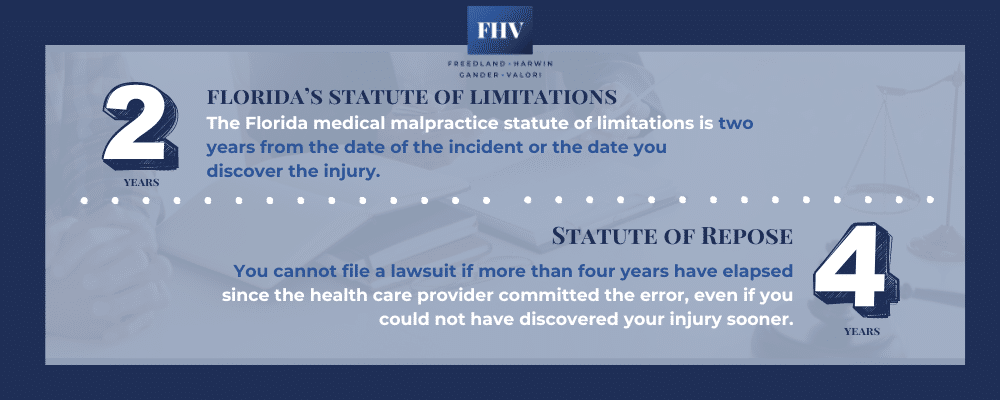
For medical malpractice in Florida, the general rule is as follows:
- Two years from the date the malpractice occurred,
or - Two years from the date you discovered, or reasonably should have discovered, that you were injured due to negligence.
However, Florida also imposes a statute of repose, which is a hard deadline that overrides the discovery rule. This means you cannot file a malpractice lawsuit more than four years after the date of the negligent act, even if you discovered the injury later.
The statute of repose exists to prevent indefinite liability, but it can be devastating for patients who don’t realize they were harmed until years later.
How Is the Discovery Date Determined?
In many malpractice cases, the injury isn’t immediately obvious. For example, a surgical instrument left inside a patient may go unnoticed for months, or a misdiagnosis may not become apparent until the condition worsens.
In such cases, the “discovery date” becomes critical. Florida law defines it as the point when you either:
- Actually knew you were injured due to malpractice, or
- Should have known, through reasonable diligence, that your injury was caused by a medical error.
Often, the discovery date aligns with the date of diagnosis or the moment a second physician identifies the previous error. However, healthcare providers or insurers may argue that you should have discovered the issue sooner, which can shorten your filing window.
If there’s disagreement, a judge may decide when the discovery date occurred, making it essential to have an experienced attorney who can document when you truly became aware of the injury.
Exceptions to Florida’s Statute of Limitations
Florida recognizes that not every case fits neatly within the two- or four-year rule. Several exceptions, known as tolling provisions, may pause or extend the time limit under specific circumstances.
These exceptions are narrow and fact-specific, so it’s never safe to assume you qualify without speaking to a lawyer. Misinterpreting the deadline could permanently forfeit your right to compensation.
Fraudulent Concealment
If a healthcare provider intentionally hides or misrepresents facts to prevent you from discovering the malpractice, Florida law allows an extension. In these cases:
- The statute of limitations extends to two years from the date you discovered the injury,
- And the statute of repose extends to seven years from the date of the malpractice.
Fraudulent concealment might involve a doctor falsifying medical records, omitting a surgical error from operative notes, or misleading you about the cause of your symptoms.
Our attorneys at FHV Legal have handled many cases where healthcare professionals concealed critical information, such as internal injuries or anesthesia errors, to protect themselves. By uncovering that concealment, we successfully extended the statute and secured compensation for our clients.
A common example is when a surgeon causes an injury during an operation but never informs the patient. Nurses, anesthesiologists, or surgical technicians who help cover up the mistake can also be liable for fraudulent concealment.
Minors
Florida law also provides an exception for minors who suffer harm due to medical negligence. Normally, the statute of limitations for a child’s claim is two years from the incident or from the date the injury is discovered.
However, the statute of repose (the ultimate deadline) is extended until the child’s eighth birthday.
This rule applies especially to birth injury cases, such as cerebral palsy or oxygen deprivation, where the effects may not be recognized for months or years after delivery.
There’s an additional nuance for children with severe neurological injuries. In these cases, families may be eligible to file a claim through Florida’s Birth-Related Neurological Injury Compensation Association (NICA), which has a five-year filing window from the child’s date of birth.
Incapacitated Adults
If the injured person is a legally incapacitated adult, the statute of limitations may be tolled (paused) until their disability or incapacity is removed.
However, no malpractice claim can be filed more than seven years after the date of the negligent act, regardless of the individual’s mental or physical capacity.
This exception often applies in cases involving patients with brain injuries, dementia, or severe cognitive impairment following surgical or medication errors.
Why the Statute of Limitations Matters
Once the statute of limitations expires, your claim is barred forever, even if the evidence clearly shows negligence. Courts have no discretion to extend or overlook these deadlines without a qualifying legal exception.
That’s why it’s crucial to speak with an attorney as soon as you suspect something went wrong with your care. Even if you’re uncertain about when the malpractice occurred or when your injury was discovered, an experienced lawyer can review your medical records and determine the correct timeline.
At FHV Legal, we act quickly to preserve your rights, gather evidence, and file your case well before the deadline.
How FHVG Can Help
Determining the correct filing deadline under Florida’s medical malpractice laws is complex — especially in cases involving delayed discovery, fraud, or multiple defendants.
Our attorneys have handled these cases for over two decades and understand how to navigate both the legal timelines and the medical evidence that drive them.
When you work with Freedland Harwin Valori Gander, you get more than experienced legal representation. You get a compassionate team dedicated to protecting your rights and your future.
We handle every step, including:
- Reviewing your medical records to identify when the injury occurred
- Consulting medical experts to confirm when the malpractice became discoverable
- Determining whether tolling or exceptions apply
- Preparing and filing your lawsuit before the statute expires
With over $2.6 billion in verdicts and settlements recovered for clients across Florida and nationwide, we have the experience and resources to take on even the most powerful healthcare institutions.
You only get one chance to file your claim on time. Let FHV Legal guide you through every step, from determining when the clock started to building a strong, evidence-based case for justice. Call (954) 467-6400 or contact us online today to schedule your free, confidential consultation.
Frequently Asked Questions About Florida’s Medical Malpractice Deadlines
If your case is filed late, the court will dismiss it. Once the statute expires, you lose your legal right to recover damages, even if your case would have otherwise been successful.
Usually yes, but if your injury was not immediately discoverable, the timeline may begin when you first knew (or should have known) that medical negligence caused your harm.
In rare cases, yes. Tolling may apply if the provider concealed the malpractice, if the patient is a minor, or if the patient is legally incapacitated.
The statute of limitations governs how long you have to file after discovering your injury. The statute of repose is a final, absolute deadline (usually four years) after which no claim can be filed, regardless of discovery.
Immediately. The sooner you act, the easier it is for your attorney to collect records, interview witnesses, and calculate the correct filing deadline.


